Yellowjacket Control
Treatment for aggressive ground nests in lawns, pastures, rockeries, and wall voids.
Ground nest and wall void treatment →
A solitary wasp passing through the garden is normal in summer. However, repeated flight patterns toward specific architectural overhangs or corners indicate an active colony establishing itself on your building.
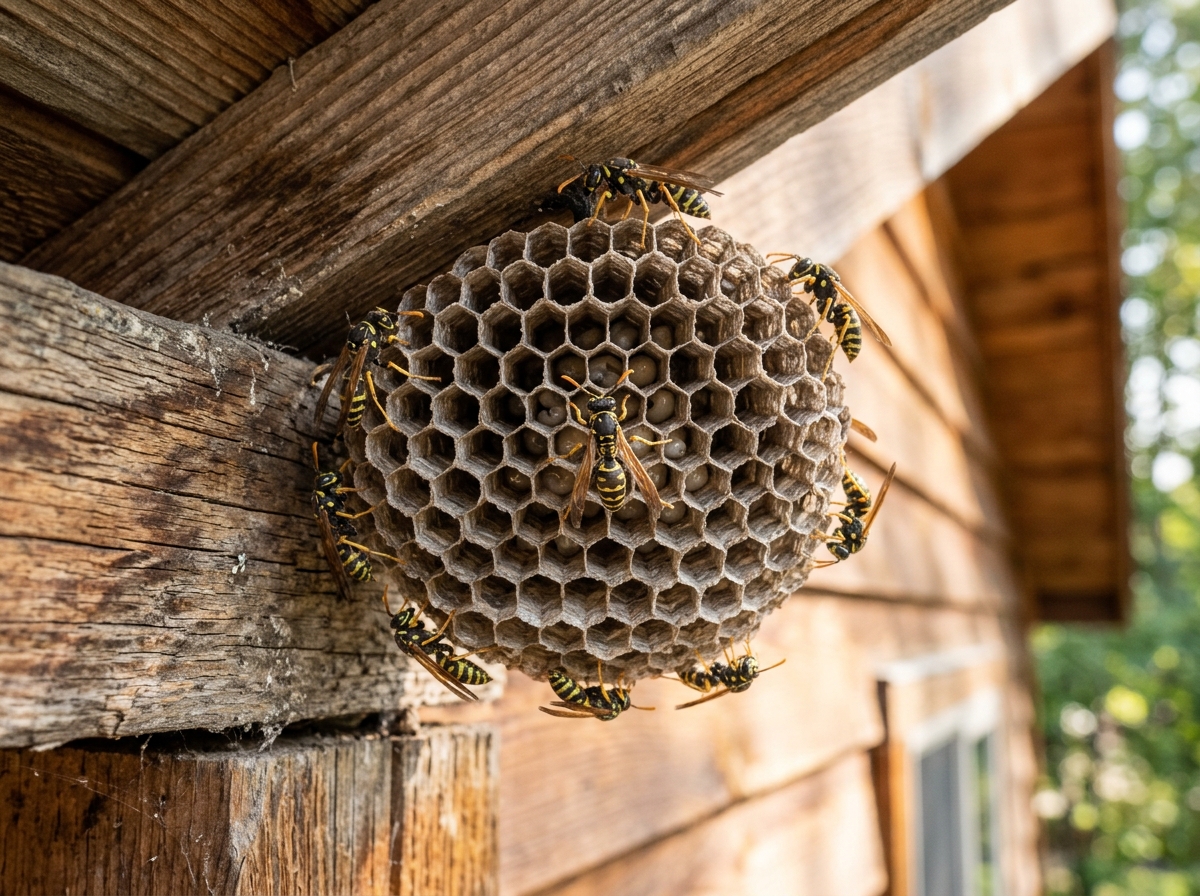
Paper wasps build open combs above ground and sting when their nest is threatened. European paper wasps look similar to yellowjackets, but paper wasps are more slender, with long legs that dangle in flight. If you see hundreds of stinging insects flying into an underground hole in the lawn or a siding void, you have yellowjackets. For ground and wall nests, see how we handle yellowjackets.
| Insect | Appearance | Nest | Where |
|---|---|---|---|
| Paper wasp (northern, European) | Slender, long legs. Northern: brown with yellow. European: black and yellow. | Open umbrella-shaped comb | Eaves, soffits, deck rails, pergolas |
| Yellowjacket | Compact, black and bright yellow | Enclosed paper nest, often underground or in wall voids | Ground holes, wall gaps, under decks |
| Bald-faced hornet | Black with ivory-white face | Large gray, teardrop-shaped enclosed nest | Trees, shrubs, eaves |
| Mud dauber | Thin thread-like waist, dark | Mud tubes or clumps | Walls, garages, under eaves |
Not a wasp? Honey bees and bumble bees are fuzzy and rounder, and they are beneficial. A local beekeeper can often relocate honey bees, so identify before treating. Mud daubers are solitary and rarely sting.
Lake homes, cedar decks, and sheltered eaves give wasps many places to build.
Spring queens emerge from winter shelter and search for warm, south-facing wooden eaves and fascias that offer warmth and shelter from rain.
Properties on Lake Coeur d'Alene, Hayden Lake, and the Spokane River feature expansive decks, docks, and cedar pergolas that offer protected undersides and abundant moisture.
North Idaho gardens provide caterpillars, spiders, and insects that adult wasps hunt to feed developing larvae in early summer, fueling rapid comb expansion.
Gaps beneath siding corners, unscreened soffit vents, and outbuildings provide winter shelter for fertile queens. Colonies do not carry over. Each spring, new queens start new nests, often in the same sheltered spots.
Here is how a visit works, from your call to the final treatment.
Call (208) 248-2701. Describe where the nest is located, how high it is, and whether it threatens a doorway or deck.
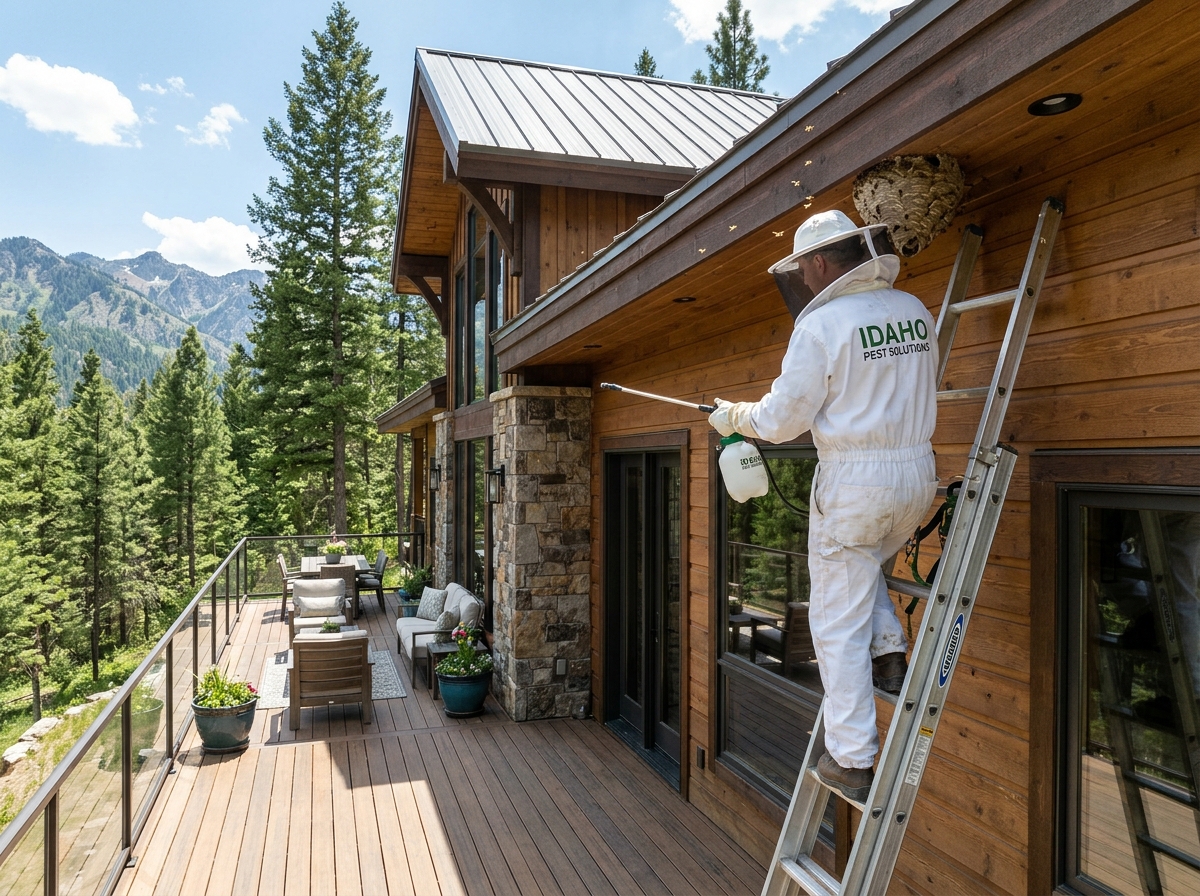
Our technician inspects all rooflines, deck undersides, eaves, pergolas, and sheds to look for active and developing nests, using telescoping tools for high eaves.
Wearing protective gear, we treat the nest and the wasps around it with a labeled insecticide for stinging insects, applied according to the label.
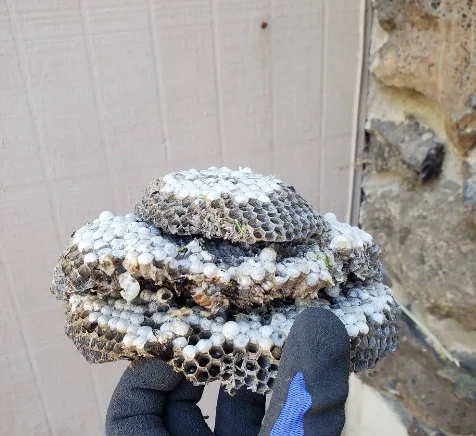
We scrape down the paper comb, eggs, and pupae so returning workers have no nest to defend.
We apply a residual treatment to the attachment surface to reduce the chance of new queens building replacement nests.
Wasp treatment costs depend on nest height, accessibility, the number of active colonies, and whether an eave and perimeter treatment is included.
Nests on first-floor porch railings require less ladder and extension gear than multi-story lake home peaks.
Single nest removal is simple; large properties with multiple paper wasp colonies along expansive eaves require broader treatments.
Open comb paper wasps differ from aggressive enclosed bald-faced hornet nests or yellowjackets in siding voids.
Adding eave and perimeter residual treatments may help reduce new nests during the summer.
Call (208) 248-2701 and describe the nest: where it is, how high, and how many you see.
Serving homes, vacation cabins, and commercial properties throughout North Idaho:
Simple preventive actions help reduce nesting temptations around your family's outdoor spaces.
Inspect eaves and railings in April and May when queens first build golf-ball sized starter nests.
Caulk cracks where fascia boards meet siding to prevent wasps from building inside wall cavities.
Keep soda cans, sweet drinks, and barbecue meats covered during patio dining to avoid attracting foragers.
Ensure outdoor garbage and recycling bins have tight-fitting lids and are rinsed clean periodically.
Install 1/8-inch wire mesh over gable vents and crawl space openings to block wasp entry.
Wasps gather pulp from weathered wood; staining decks and fences reduces nesting material on-site.
Wasp nesting cycles and peak activity vary across Idaho's distinct regional climates. Property owners in southwestern valleys often require early-season boise wasp control and residential boise wasp removal as temperatures heat up quickly by late May. In contrast, higher-elevation eastern communities face compressed mid-summer cycles where prompt wasp control rexburg id techniques protect homes before early autumn freezes. Across North Idaho and Coeur d'Alene, our pine-covered lakeside microclimates keep paper wasps and yellowjackets active throughout summer and late into fall.
Fertilized queens emerge from winter shelter in April/May to begin building small hexagonal nests under eaves.
Worker populations swell to dozens of insects per nest, actively foraging and expanding comb sizes across decks.
As natural insect prey declines, wasps, especially yellowjackets, seek sugary foods and become more defensive before freezing weather.
Worker wasps die off in freezing temperatures while newly mated queens shelter inside wall voids and attics.
Direct answers about wasp nest removal and safety in Coeur d'Alene.
Ask About Wasp Removal: (208) 248-2701Price depends on nest height, access, the number of nests, and the species. Tell us where the nest is, how high it is, and how many you see, and we'll go over the cost.
We treat the nest with a labeled insecticide for stinging insects, detach the comb, and apply a residual treatment to the attachment point to discourage rebuilding.
Re-entry time is set by the label of the product used. Ask your technician which product was applied, and keep kids and pets away from the treated area until the label's re-entry time has passed.
Foragers that were away from the nest during treatment may return to the old site for a short time. If you still see activity after that, call (208) 248-2701.
Usually not. Wasp colonies do not survive winter, and old paper nests are rarely reused. However, newly fertilized queens frequently seek out the same sheltered eave or deck locations each spring, which is why we treat the attachment point with a residual barrier to discourage rebuilding.
Disturbed nests release defending wasps quickly, many stings happen on ladders, and over-the-counter sprays often fail to reach hidden combs. Trapped wasps can chew through walls or attack in swarms. Our technicians use professional protective equipment and telescoping tools to eliminate nests safely from ground level.
Yes. Elevation and regional temperatures shape how early queens emerge and how large colonies grow. In the hotter Treasure Valley, requests for boise wasp control and preventative boise wasp removal peak early as colonies expand under sunny eaves. In higher eastern elevations, homeowners frequently seek seasonal wasp control rexburg id services during intense, short-window summer nesting periods. In North Idaho, lake humidity and wooded eaves keep colonies active from spring right up until sustained freezing temperatures arrive in late autumn.
Other stinging insect and exterior pest solutions for North Idaho properties
Treatment for aggressive ground nests in lawns, pastures, rockeries, and wall voids.
Ground nest and wall void treatment →Web de-webbing and exterior barrier treatments around roof eaves, windows, and patios.
Spider web removal →Lakeside foliage fogging and yard barrier treatments for bite-free outdoor entertainment.
Mosquito control for lake properties →Targeted treatments for pavement ants, odorous house ants, and carpenter ants.
Carpenter and pavement ant control →Tell us where the wasp nest is located, how high it is, and what type of activity you are seeing. We will inspect, remove the hazard safely, and ensure your outdoor areas are secure.
Direct Phone
(208) 248-2701Service Headquarters
Coeur d'Alene, Idaho
Business Hours
Monday to Friday: 7 AM to 7 PM
Saturday: 8 AM to 4 PM